
Atlanta Yard Drainage Solutions: How to Fix Slope and Erosion Problems
Standing water, washed-out mulch, and a soggy strip of lawn are symptoms, not the problem. The fix starts by tracing where the water begins — not by choosing a drain.
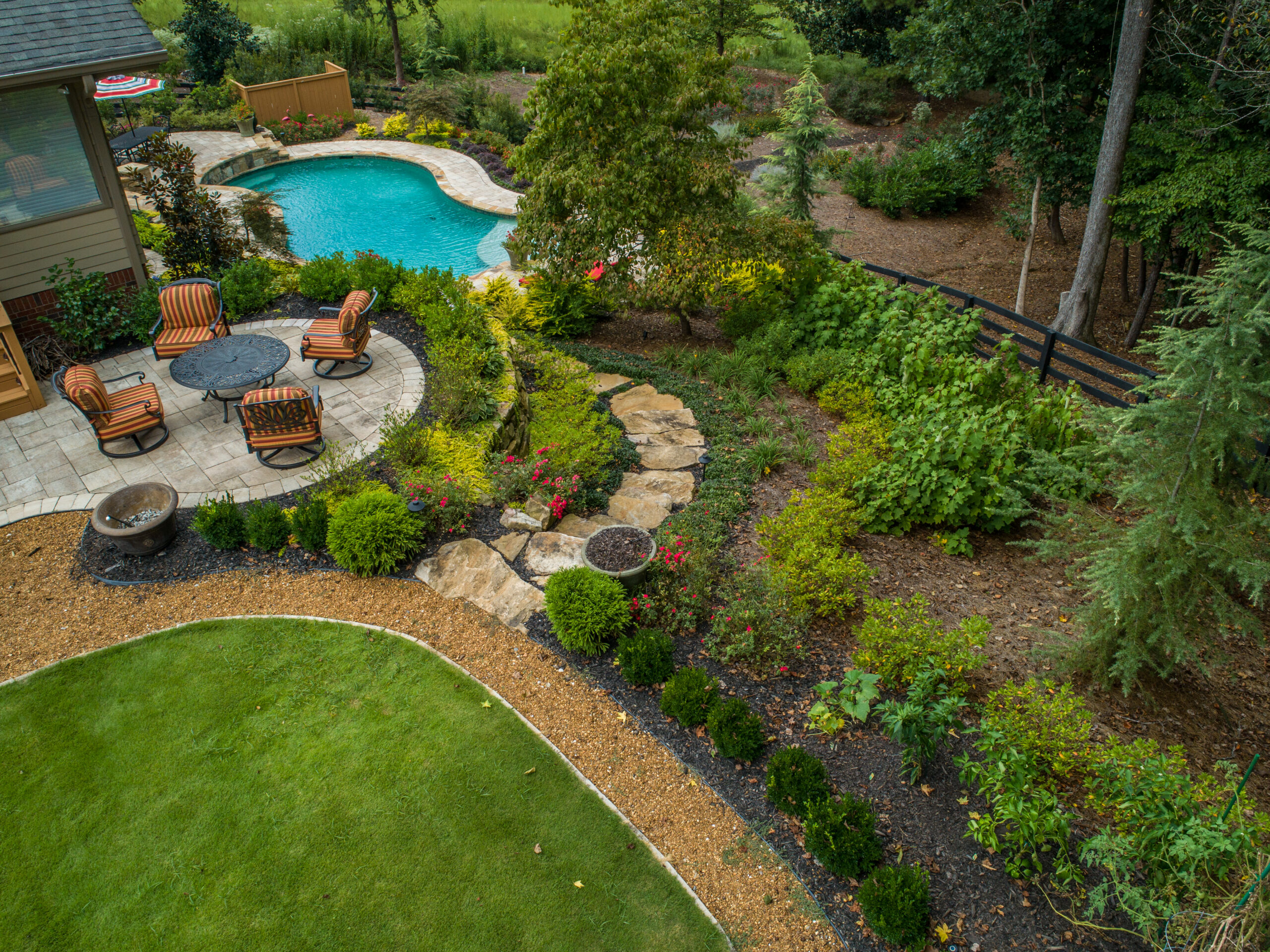
Water moves across the whole property, which is why a drainage problem at the patio often starts somewhere else entirely.
In this article
The short answer
Start by tracing where water begins, where it collects, and where it can legally and safely go. Slope, clay soil, roof runoff, downspouts, compacted beds, patios, retaining walls, pool decks, and irrigation can all contribute. The right fix may involve grading, swales, drains, wall drainage, planting changes, or a broader outdoor living redesign — usually more than one of those.
Water leaves evidence
A drainage problem leaves a trail. Mulch washes out. Turf thins. Soil collects on paths. Patio joints hold silt. A wall stays dark and damp days after rain. Pool decking sheds the wrong direction. A low area of lawn goes soft after every storm. Read those clues before choosing a fix, because they point upstream to the cause.
Around Roswell and North Atlanta, most yards combine slope, clay soil, mature trees, roof runoff, hardscape, and outdoor living features. Water does not respect the boundary between landscape and construction. A problem near a patio may start at a downspout thirty feet away. A soggy lawn may come from a compacted base beside a path. A washed bed may reveal a missing swale or a broken irrigation line.
Do not start with a product
French drains, dry creek beds, catch basins, swales, grading, retaining walls, and planting changes can all be useful, but none should be chosen before the water path is understood. A drain in the wrong place collects almost nothing. A dry creek bed without a real outlet is decoration. A wall without drainage makes the pressure worse, not better.
Our outdoor living services treat drainage and irrigation as water management, grading strategy, and protection below the surface. That is the right lens. Drainage is not a separate line item from the outdoor plan — it is what protects patios, pool areas, walls, turf, planting, kitchens, and paths from the thing most likely to damage them.
| Symptom | Possible cause | What to check |
|---|---|---|
| Standing water near a patio | Poor pitch, compacted base, roof runoff, or a blocked outlet. | Slope, drains, downspouts, patio elevation, and soil. |
| Mulch washing out | Concentrated flow from slope, roof, or irrigation. | Water entry point, bed edge, plant cover, and outlet path. |
| Erosion at a wall | Missing wall drainage, or water cutting around the base. | Backfill, drain pipe, outlets, and runoff from above. |
| Wet strip of lawn | Low grade, compaction, irrigation leak, or shade stress. | Soil, irrigation zones, sun exposure, grading, and foot traffic. |
That third row is worth expanding on. Water behind a wall adds pressure and moves soil, which is why drainage decides whether a wall holds — our guide to retaining walls in Roswell GA covers how backfill, drain pipe, and outlets work together.
The fix is usually layered
Most drainage repairs need more than one move. Grading redirects surface water. Swales carry it across a lawn. Pipe collects it from low points. Downspout extensions move roof water away from foundations and patios. Wall drains relieve pressure. Planting slows runoff and holds soil. Hardscape adjustments stop water from crossing a seating area on its way through.

Grade transitions are where drainage decisions become visible. Handled well, the solution reads as design rather than repair.
The fix should match the finished yard. A dry creek bed can be genuinely beautiful when it belongs to the planting plan. A drain can disappear beneath a path when the outlet is managed. A swale can become part of the lawn's shape. The best drainage work tends to look like landscape design, because the technical solution has been blended into the yard rather than bolted onto it — the same logic that governs hardscape design in Atlanta, where pitch and base decide how long a patio lasts.
Irrigation can hide inside the problem
Not every wet spot is stormwater. Overspray, broken heads, poor coverage, or a scheduling error can produce soggy beds and dry turf in the same yard. Before rebuilding hardscape or trenching for a drain, check irrigation zones, run times, head direction, and leaks. Water management means addressing both too much water and too little.
Georgia's outdoor water use schedule and UGA's water-wise landscape guide for the Georgia Piedmont are useful background when planning planting and irrigation. Practically: group plants by water need, keep irrigation off hardscape, and design new planting and new drainage at the same time rather than in sequence.
What a drainage consultation should answer
- Where does water enter the problem area? Trace rooflines, downspouts, slopes, patios, walls, and neighboring grades.
- Where does it collect? Mark puddles, soft turf, washed mulch, silt lines, and stained hardscape.
- Where can it go? The outlet has to be legal, controlled, and compatible with the rest of the yard.
- What needs protecting? Patios, pools, walls, foundations, beds, and paths should guide the repair.
- How will the fix look? Drainage should sit inside the outdoor living design, not appear as an afterthought across it.
Settle the outlet before anything gets dug
The single question that stalls drainage projects is where the water finally goes. An outlet has to daylight somewhere with enough fall to keep moving, and it cannot simply become a neighbor's problem. On flat back sections or tight lots, that question sometimes changes the whole approach — from collecting water to slowing and absorbing it instead. Answer it during design, not once a trench is already open.
Two other items belong in the same conversation. Utilities and irrigation lines should be located before trenching, since drainage runs tend to cross exactly the ground everything else was buried in. And it is worth asking what maintenance the finished system needs — basins and pipe outlets collect debris, and a drain nobody clears is a drain that stops working in about three seasons.
Protect the yard that stays
Drainage work means equipment and open trenches across finished ground. Trees, roots, irrigation, masonry, pool equipment, and lawn all need a protection plan before staging begins.
Frequently asked questions
What is the best yard drainage solution?
The best solution depends on where water starts, where it collects, the soil, the slope, existing hardscape, irrigation, and where water can safely go. There is no single product that fits every yard.
Can landscaping fix erosion?
Yes, when grading, drainage, planting, walls, ground cover, and water outlets are planned together. Planting alone rarely fixes concentrated runoff.
Why does my Atlanta yard stay soggy?
Common causes include clay soil, low spots, poor grading, roof runoff, irrigation leaks, compacted soil, blocked drains, and shade stress. Several often act together.
Should drainage be planned before a patio or pool?
Yes. Drainage should be planned before or during patio, pool, wall, and planting work so water does not undermine the finished outdoor space.
Fix the cause, not the puddle
Drainage work should leave the whole yard more stable and more usable, not just move one wet spot somewhere else. Landscape Studio Group can trace the water, protect the outdoor living investment already in the ground, and blend the solution into the finished design. Where a pool is involved, deck drainage and discharge are planned through our poolside services as part of the same system.
Photograph it while it is wet
The most useful thing you can bring to a drainage consultation is a photo taken during or just after heavy rain, showing where water sits and which direction it runs.